If you’ve felt like the construction market has been holding its breath for the past year, you’re not imagining it. Some sectors are sprinting, others are still finding their footing, and a few are quietly resetting for the next cycle.
If you’re an owner or developer trying to figure out where to put capital, this is the moment to get specific about your strategy. Here’s the read on commercial, industrial, and multifamily construction as we move through the back half of the year.
The Big Picture
Total nonresidential construction spending is expected to grow modestly this year, heavily concentrated in a handful of sectors — data centers, power generation, healthcare, and public infrastructure.
Commercial, industrial, and residential segments continue fighting through material cost inflation, labor shortages, and elevated borrowing costs. Meanwhile, the broader construction economy is still expected to top roughly $1.27 trillion in 2026, growing around 5.6% year-over-year.
The theme that keeps surfacing in conversations with contractors and developers all year is this: uncertainty has quietly replaced urgency. A few years ago, the anxiety was about getting materials before prices jumped again. Now it’s about whether financing, tariffs, and demand will line up long enough to justify breaking ground at all.
Industrial
If you’d asked most developers a year ago whether warehouse construction would be accelerating again by mid-2026, you’d have gotten a lot of skeptical looks. And yet, here we are.
The numbers tell the story:
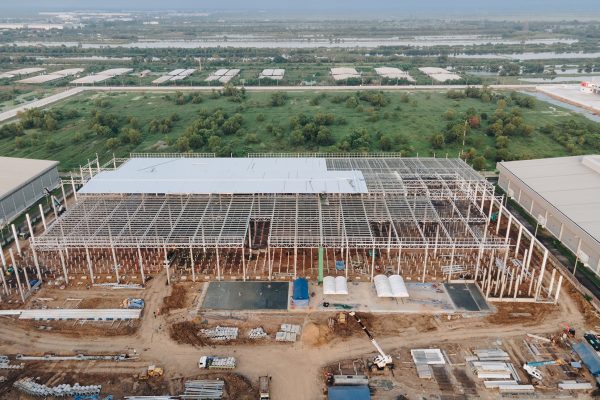
- U.S. warehouse construction climbed 18% year-over-year in Q2 2026, with more than 305 million square feet currently under construction — the second consecutive quarter of year-over-year growth after a prolonged slump.
- Net absorption hit 62.1 million square feet in Q2 — the second time in three quarters that demand has topped 60 million square feet, signaling a real reacceleration rather than a one-off spike.
- National industrial vacancy fell to 6.9%, edging down as developers throttled back speculative building in 2024–2025, which is now compressing the supply-demand gap.
What’s driving it?
Data centers. Not directly — most of this growth is warehouse space needed to support data center supply chains, from equipment staging to component storage. Hyperscalers like Meta and Google are also leasing adjacent industrial space to stage gear for their AI campuses, creating a second-order demand wave that’s rippling into markets.
This means:
- Markets near major data center corridors are tightening faster than the national average — don’t rely on national vacancy numbers to price risk in those submarkets.
- New industrial product takes 18–24 months from groundbreaking to delivery, so the capacity breaking ground now won’t hit the market until late 2027 into 2028. If you’re planning a logistics facility, the window to capture near-term tenant demand is now.
- Cold storage and micro-fulfillment are becoming their own asset class as online grocery delivery keeps expanding, pushing demand for urban, last-mile facilities with heavier power loads and automation-ready floor plans.
The data center sector itself remains unbelievably tight — vacancy has held around 1% for three straight years despite record construction, and most tenants signing leases today are locking in space for 2028 deliveries. If you have land near power infrastructure, you already know what that’s worth.
Multifamily
Multifamily has been living through the biggest apartment supply wave since the early 1980s, and 2026 is the year that starts to slowly ease.
Where things stand:
- Multifamily completions are projected to drop sharply in 2026 — one major forecast puts the decline at 24%, down to roughly 450,000 units from about 595,000 in 2025, with further tapering into 2027.
- Starts have already fallen more than 40% between 2023 and 2025, driven by high material costs, elevated rates, and lingering oversupply concerns, particularly across the Sun Belt.
- National rent growth forecasts for 2026 are modest but positive — most projections cluster around 1–2%, with acceleration expected in 2027 and beyond as the supply works itself out.
Geography matters more than the national average. This is really a story of two Americas right now: oversupplied Sun Belt and Mountain West markets are still absorbing a wave of recent deliveries, while limited-construction Midwest and Northeast markets are holding pricing power. Some of the standout vacancy rates: Sarasota, Huntsville, San Antonio, Memphis, and Baton Rouge are all running double-digit vacancy, while markets like Boston, D.C., Indianapolis, and Kansas City are seeing tighter conditions and healthier rent growth in the 1.7–2.1% range.
What does this mean if you’re developing:
- If your pipeline is in an oversupplied Sun Belt submarket, expect concessions and lease-up friction to persist into 2027 — price your pro forma accordingly.
- Markets with limited new supply and steady job growth are quietly becoming the better bet for new starts breaking ground now, since by the time they deliver in 18–24 months, some of today’s oversupply should have cleared.
- Office-to-residential conversions nearly doubled in 2025, and cities are throwing real incentives at it: Boston is offering a 75% tax abatement over 29 years for office-to-housing conversions, Manhattan saw 4.1 million square feet of office converted to residential in 2025 (up from 1.6 million in 2023), and Missouri is dangling tax credits covering up to 25% of conversion costs. If you own aging office stock, this is worth a serious feasibility look.
- Barriers to homeownership — a roughly 105% monthly cost premium to buy versus rent, an estimated 3.4-million-unit shortage of single-family homes, and high mortgage rates — are keeping renter demand structurally supported even as supply cools.
Commercial
Commercial isn’t really one market it’s several, moving in opposite directions.
Office and retail continue to lag, hampered by shifting space utilization, tighter financing, and softer business demand. But that weakness is exactly what’s fueling the adaptive reuse boom mentioned above — hotel conversions to multifamily have outpaced office conversions for two years running, alongside conversions of industrial buildings, warehouses, and even schools. Commercial-to-multifamily conversions now account for a little over 7% of all multifamily units built nationally.
Data centers and mission-critical construction are the undisputed growth engine. U.S. data center construction starts hit an estimated $77.7 billion in 2025 — a 190% jump — and 2026 is tracking to be even bigger, with dozens of new projects worth tens of billions already breaking ground in the first half of the year alone.
The six largest U.S. hyperscalers are projected to spend around $700 billion in capital expenditures this year, and JLL estimates roughly 100 gigawatts of new data center capacity will come online between 2026 and 2030 — more than $1 trillion in real estate value creation, plus another $1–2 trillion in tenant fit-out spending.
For owners and developers, the strategic read is:
- If you’re not in data centers or adjacent industrial, differentiation matters more than ever. Pre-leased, phased, or adaptive-reuse projects are getting financed; speculative ground-up commercial is a much harder sell in this rate environment.
- Institutional and healthcare construction (aging facilities, federal investment, demographic demand) remain reliable growth categories if you’re looking to diversify away from rate-sensitive asset classes.
- Regional divergence is real — the Southwest, for instance, is riding a wave of semiconductors, data center, and advanced manufacturing megaprojects that’s making it one of the strongest commercial construction markets in the country right now.
Cost and Labor
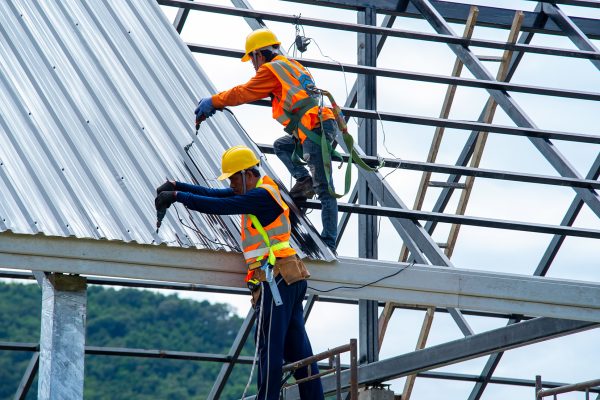
No conversation about 2026 is complete without tariffs and labor, because both are reshaping how projects get budgeted and staffed.
Costs: Material prices in 2025 averaged about 4.2% above 2024 levels, and current tariff policy is expected to push aggregate construction cost escalation to somewhere in the 4–8% range for 2026, depending on the material mix. Steel and aluminum remain especially exposed — steel prices are up roughly 13% and aluminum around 23% year-over-year in some readings — while copper stays tight on demand from data centers and electrical infrastructure.
Labor: This is the tighter constraint of the two. The industry needs to attract an estimated 350,000+ new workers in 2026, climbing toward 456,000 in 2027, according to Associated Builders and Contractors — and most of that gap comes from retirements, not new demand. Electricians and mechanical trades are the binding constraint on data center and mission-critical projects specifically, and immigration enforcement is expected to hit construction labor supply harder than most other industries.
What owners and developers are doing about it:
- Procuring long-lead materials earlier and building bigger contingencies into budgets — volatility, not steady escalation, is the new baseline.
- Locking in skilled trade partners and superintendents with relevant experience well before groundbreaking, especially for anything electrically intensive.
- Favoring capital-disciplined, pre-leased, or phased delivery structures over speculative builds.
Bringing It All Together
The common denominator across every sector is that fundamentals are sound; what separates successful project outcomes from the rest is disciplined underwriting, early procurement, and the right financing structure to weather tariff and labor volatility.
That’s where a partner like KBCm Group can add real value — helping owners and developers’ pressure-test deals, structure capital, and move decisively on the opportunities this market rewards.
If you’re weighing your next project against these trends, now’s the time to have that conversation – contact Skyler at 940-366-2231 or sblankenfeld@kbcmgroup.com to discuss current or new projects.